Esophageal feeding tube placement

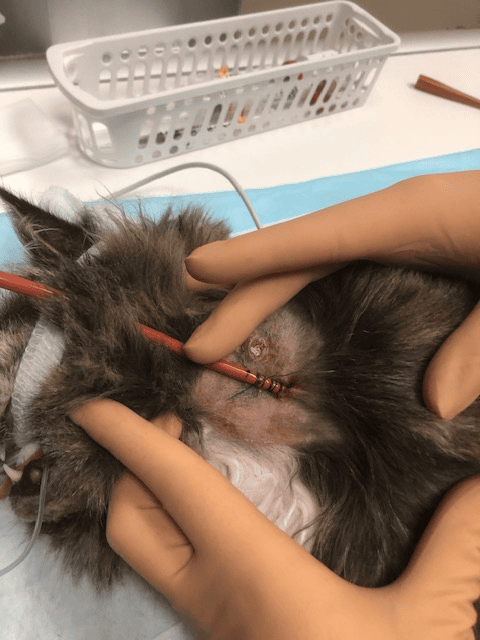
Esophagostomy tubes can be very valuable in dogs and cats with hypo- or anorexia. Placement of an esophagostomy tube has several advantages:

  • The placement is technically not difficult and is inexpensive.
  • Esophagostomy tubes are generally well tolerated by dogs and cats.
  • The animal can still eat voluntarily.
  • A wide variety of diets can be administered through the tube.
  • Oral medications can be administered through the tube.
  • The tube can remain in place for a long period of time (up to several months).

Esophagostomy tubes are not recommended in animals with esophageal disease. Life-threatening complications are uncommon. In a recent retrospective study of 225 dogs and cats with an esophagostomy tube, the most common complications were tube dislodgement or loss, clogging or obstruction, inflammation around the tube site, and skin irritation.

An esophagostomy tube can be placed in several ways. In this Vet Info sheet, we describe two methods for placing an esophagostomy tube.

For both methods, the animal is positioned in right lateral recumbency and the hair is clipped from the mid-cervical region to the thoracic inlet. The skin is then surgically prepared (disinfected with chlorhexidine and alcohol).

First method

For the first method, a red rubber feeding tube can be used. The required materials are:
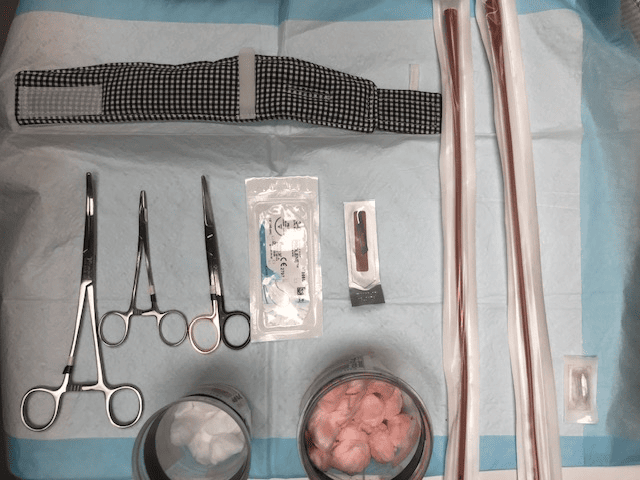
  • Esophagostomy tube: A tube of appropriate size and type, depending on the size of the animal and the purpose of the tube (feeding, medication, etc.). In cats, a 10 Fr tube is typically used. Measure the distance from the mouth to the 7th–8th intercostal space and mark this distance on the tube.
  • Sterile gloves
  • Scalpel blade
  • Mosquito hemostat
  • Needle holder
  • Non-absorbable suture material
  • Gauze with antiseptic ointment
  • Vet wrap or a kitty collar for the esophagostomy tube

Second method

Another method for placing an esophagostomy tube is by using a MILA tube.

Required materials:

  • MILA esophagostomy tube: A tube of appropriate size and type depending on the size of the animal and the purpose of the tube (feeding, medication, etc.). In cats, a 10 Fr tube is typically used. Measure the distance from the mouth to the 7th–8th intercostal space and mark this distance on the tube.
  • MILA tunneler: A specialized instrument supplied with MILA esophagostomy tubes that facilitates placement of the tube.
  • Sterile gloves
  • Scalpel blade
  • Needle holder
  • Non-absorbable suture material
  • Gauze with antiseptic ointment
  • Vet wrap or a kitty collar for the esophagostomy tube

The following YouTube video demonstrates how to place a MILA esophagostomy tube using the MILA tunneler.

Click here to go to video.

Regardless of the method used, the esophagostomy tube should be secured using a Chinese finger-trap suture.

Before placing this suture, it is important to take a thoracic radiograph (lateral view) to confirm that the tip of the esophagostomy tube is positioned correctly (at the level of the 7th to 8th intercostal space).


Once the tube is secured, place a piece of gauze with antiseptic ointment over the tube insertion site. Then apply a bandage (Vet Wrap) around the neck. Alternatively, specially designed feeding tube “kitty collars” can be used.

References

  • Nathanson O et al. Esophagostomy tube complications in dogs and cats: Retrospective review of 225 cases. J Vet Intern Med 2019;33(5):2014-2019

Related Posts

June 7, 2025

Antibiotics in Acute Diarrhea (ENOVAT guidelines)

The use of antibiotics in dogs with acute diarrhea is a widely discussed topic in veterinary practice. Most cases of diarrhea are self-limiting and resolve...

June 7, 2025

Diagnosis of Feline Infectious Peritonitis (FIP)

Feline Infectious Peritonitis (FIP) is a complex and serious viral disease affecting cats. It is caused by a mutation of the feline coronavirus (FCoV). FIP...

June 7, 2025

Extracorporeal therapies

Extracorporeal therapies are medical treatments in which blood or other bodily fluids are removed from the body, treated externally, and then returned. These therapies are...