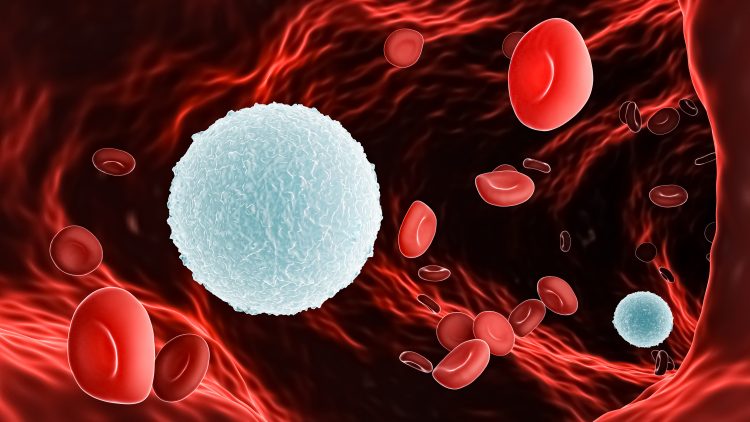
In our previous Vet Info, we briefly discussed the main abnormalities that can occur in erythrocytes. In this Vet Info, we will focus on leukocytes, or white blood cells, and review the most important changes that can be seen.
There are five types of leukocytes: neutrophils, lymphocytes, eosinophils, basophils, and monocytes. When interpreting leukocyte numbers, it is always recommended to look at the absolute counts rather than the percentages.
An increased leukocyte count, or leukocytosis, or a decreased leukocyte count, or leukopenia, is most often caused by an increase or decrease in the number of neutrophils. Toxic changes in leukocytes, which can be seen on a blood smear, will not be discussed here.
Neutrophilia
Neutrophilia may be physiological, for example in response to stress or exercise. In these cases, the increase is usually mild to moderate, typically no more than twice the upper reference limit, and there is no left shift.
Neutrophilia is a relatively non-specific finding and may be seen with inflammation, neoplasia, immune-mediated disease, or glucocorticoid administration.
- A left shift means an increased number of immature, band neutrophils. Its presence suggests a more severe disease process.
- A regenerative left shift means that there are more mature neutrophils than immature neutrophils.
- A degenerative left shift has a poorer prognosis. In this situation, the total leukocyte count is not increased, and may even be decreased, while there are more immature than mature neutrophils.
Neutropenia
Neutropenia can be classified as mild, moderate, or severe:
- Mild: 1,500–3,000/µL
- Moderate: 500–1,500/µL
- Severe: <500/µL
Possible causes include:
- Decreased bone marrow production, for example due to infection such as parvovirus or Ehrlichia, intoxication such as estrogen, chloramphenicol, or methimazole, or neoplasia
- Immune-mediated destruction
- Increased consumption, for example in sepsis
Lymphocytosis
Possible causes of mild lymphocytosis include:
- Stress, especially in young animals and cats
- Mild inflammation
- Infections, such as FIV, FeLV, toxoplasmosis, or Ehrlichia
- Addison’s disease
Marked lymphocytosis should raise suspicion for neoplasia, particularly lymphoid leukemia or stage V lymphoma.
Eosinophilia
Benign causes of eosinophilia include:
- Allergies, for example flea allergy or food allergy
- Parasitic infections, such as angiostrongylosis or heartworm disease
- Addison’s disease
More serious causes include:
- Mast cell tumors
- Tissue infiltration with eosinophils, for example eosinophilic bronchopneumonia or eosinophilic enteritis
- Paraneoplastic eosinophilia, which has been described with several types of tumors
- Hypereosinophilic syndrome, especially in Rottweilers
Monocytosis
Monocytosis may be caused by:
- Acute or chronic inflammation
- Glucocorticoids
- Chronic granulomatous disease, especially fungal infections
- Myelomonocytic leukemia
Stress leukogram and reverse stress leukogram
A stress leukogram, caused by endogenous or exogenous glucocorticoids, can look identical to an inflammatory leukogram.
Both are characterized by:
- Neutrophilia
- Lymphopenia
- Eosinopenia
- Monocytosis
The distinction should be made based on the clinical picture and other laboratory findings. Fever, a left shift, hypoalbuminemia, and hyperglobulinemia support inflammation, while hyperglycemia is more suggestive of stress or exogenous glucocorticoid administration.
A reverse stress leukogram can be seen in Addison’s disease and is characterized by:
- Neutropenia
- Lymphocytosis
- Eosinophilia
- Monocytopenia